Articles
Category Construction Progress Show all
-
Multi-trade rack mock-up in Coquitlam
Share Multi-trade rack mock-up in Coquitlam on Facebook Share Multi-trade rack mock-up in Coquitlam on X (formerly Twitter) Share Multi-trade rack mock-up in Coquitlam on Linkedin Email Multi-trade rack mock-up in Coquitlam link
On February 22 and 29, members from the DCDH PMO, Graham, HDR and subcontractor representatives attended an in-person mock-up review of a typical multi-trade rack in Coquitlam to provide feedback and discuss the pre-fabrication design.
 A multi-trade rack (MTR) is a steel frame structure that contains elements such as ductwork, water lines, heating pipes, sprinkler lines, valves, VAV boxes, steel studs and drywall, electrical components and anything else that is located in the ceiling of a corridor.
 Part of the project strategy is to pre-fabricate large components of the new Dawson Creek & District Hospital using MTRs. There will beContinue reading
-
Level 1 suspended slab pours
Share Level 1 suspended slab pours on Facebook Share Level 1 suspended slab pours on X (formerly Twitter) Share Level 1 suspended slab pours on Linkedin Email Level 1 suspended slab pours link
We’re excited to share that concrete pours for the Level 1 (L1) suspended slab are underway! The first pour was done on January 25 and the remaining pours will continue until mid-April. Once all 10 pours for L1 are complete, ~2510m3 of concrete will have been poured.

Fun fact: Heidelberg Materials, Dawson Creek is supplying all of the concrete for the suspended slabs and CanaSteel Rebar Services, Dawson Creek is supplying and installing all the reinforcing steel.
Suspended slabs are upper floor concrete slabs that are not in direct contact with the ground. The slab is supported on theContinue reading
-
Ground heating and new temperature monitoring system
Share Ground heating and new temperature monitoring system on Facebook Share Ground heating and new temperature monitoring system on X (formerly Twitter) Share Ground heating and new temperature monitoring system on Linkedin Email Ground heating and new temperature monitoring system link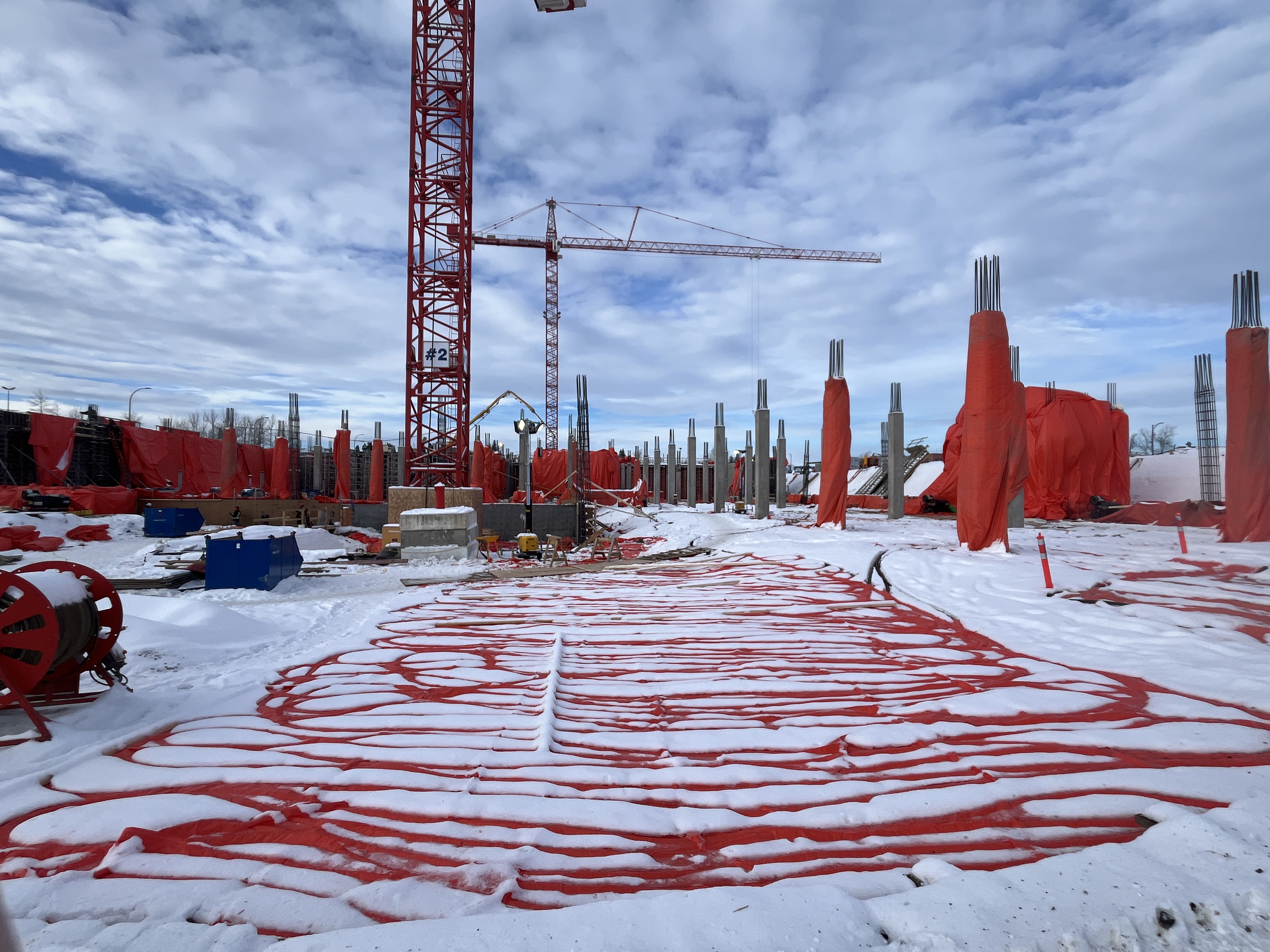
Graham Design Builders prepared for the winter months by implementing their frost protection plan to maintain temperature levels of the foundation subgrade, thereby allowing concrete work to continue through the winter and protecting the ground from frost. This included procuring and installing ground thaw machines and natural gas lines.

Graham has sourced a new-to-market temperature monitoring system to complement the ground thaw machines. The new system provides real-time temperatures of the subgrade to their cellular devices and allows them to turn down or shut off the heaters when they’re not needed. It also ensures compliance, reduces costs, and helps theContinue reading
-
Tower crane #2 installed
Share Tower crane #2 installed on Facebook Share Tower crane #2 installed on X (formerly Twitter) Share Tower crane #2 installed on Linkedin Email Tower crane #2 installed link
There's been a new addition to the Dawson Creek skyline with the installation of the second tower crane.
Check out this timelapse video of the installation process.
Read more about the first tower crane and the important role that cranes play on construction sites.


-
More concrete pours and winter weather preparation
Share More concrete pours and winter weather preparation on Facebook Share More concrete pours and winter weather preparation on X (formerly Twitter) Share More concrete pours and winter weather preparation on Linkedin Email More concrete pours and winter weather preparation link
If you’ve driven or walked by the site of the new hospital recently, you might have seen a sea of vibrant orange tarps across the site. Graham is planning and preparing for the winter months and starting to implement their frost protection plan.
It’s fundamental that heat and moisture control is addressed throughout the construction process during the winter months. This includes controlling the temperature and protecting the concrete foundations to avoid a negative impact on the quality of the installation and possible re-work, if not done correctly.
One of the biggest risks during the winter is the frost impactContinue reading
-
Over 300 jobs anticipated; locals already involved in the project
Share Over 300 jobs anticipated; locals already involved in the project on Facebook Share Over 300 jobs anticipated; locals already involved in the project on X (formerly Twitter) Share Over 300 jobs anticipated; locals already involved in the project on Linkedin Email Over 300 jobs anticipated; locals already involved in the project link
A new hospital for the community means more than just investing in health-care, it also means economic opportunities for the region. Construction on the new hospital just started, but local businesses and workers are already involved in and benefiting from the project.
Wherever possible, Graham Design Builders LP is prioritizing working with and hiring local and regional businesses. Local hospitality businesses are also benefitting from workers being in town and renting hotel rooms or houses for weeks or months at a time.
Check out this document (Local and regional businesses) to view the list of just some ofContinue reading
-
Reaching new heights: Tower cranes
Share Reaching new heights: Tower cranes on Facebook Share Reaching new heights: Tower cranes on X (formerly Twitter) Share Reaching new heights: Tower cranes on Linkedin Email Reaching new heights: Tower cranes link
The Dawson Creek skyline has a new look! From most areas of the city you can spot the first tower crane that has been erected on the site of the new Dawson Creek & District Hospital.
Crane #1 is 50 metres tall with a jib length of 75 metres. Crane #2 will be erected within the next month and will be 41 feet tall and have a jib length of 60 metres. Both cranes will remain on site for the next 16 months.
Tower cranes are an important piece of equipment that are used on construction sites to lift andContinue reading
-
Check out the new DCDH construction camera!
Share Check out the new DCDH construction camera! on Facebook Share Check out the new DCDH construction camera! on X (formerly Twitter) Share Check out the new DCDH construction camera! on Linkedin Email Check out the new DCDH construction camera! link
The DCDH Construction Camera is now available! That means any day, any time, you can see what progress is being made on the construction of the new hospital.
You can see live snapshots, zoom in and out and side to side, compare photos from different days, go back in time for archived snapshots, and view timelapses.
 Photo from 09-05-2023 @ 3:34pm
 -
Pouring concrete
Share Pouring concrete on Facebook Share Pouring concrete on X (formerly Twitter) Share Pouring concrete on Linkedin Email Pouring concrete link
Last week, mud slabs were poured for one of the crane bases and a few of the foundations on the southwest corner of the building footprint.


-
New sidewalk and temporary parking lot
Share New sidewalk and temporary parking lot on Facebook Share New sidewalk and temporary parking lot on X (formerly Twitter) Share New sidewalk and temporary parking lot on Linkedin Email New sidewalk and temporary parking lot link
A new sidewalk has been built and work is underway for a new temporary parking lot on the southwest corner of Northern Lights College’s campus.
Graham has been collaborating with NLC on the site logistics plan and identified the need for additional parking for workers to reduce the amount of parked vehicles around the site. NLC reached an agreement with Graham to allow them to use the vacant corner of their campus property for a temporary parking lot with over 200 parking stalls.
With winter quickly approaching, a safe walking path is also needed for workers to get from theirContinue reading


